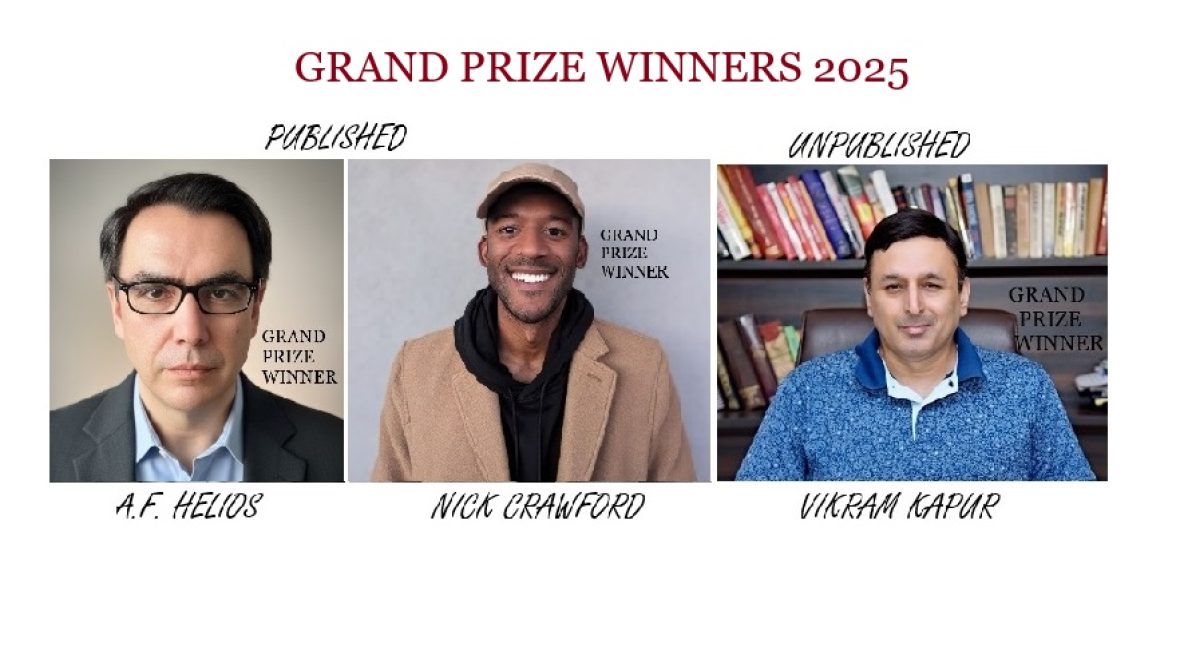

How does it feel to be the grand prize winner of an international book contest?
I’m thrilled to be the grand prize winner of the Eyelands awards. This is my first time winning a contest outside of North America, and the fact that the contest is based in Greece, the birthplace of Western literature, is mind-blowing to me.
How did you hear about the contest?
I Googled contests that accept short story collections.
When did you start writing?

I always had an interest in reading when I was young. I never thought of the books I read as “literature,” or of having any kind of point beyond absorbing me into a good story. I started writing when I was in my early twenties, (bad) poetry at first, then short stories. I was terrible, so decided to take classes and workshops in university, and have been writing steadily ever since.
I can see from your bio that you have won a lot of distinctions for your writings. Is this the first time that one of your stories will be translated in another language
Yes! This blows my mind.
You wrote an excellent book. What was the inspiration for ‘’Pagodas of the Sun–Japan Stories’’?
I lived and worked in Japan from the late 1990’s to the early 2000’s as an ESL teacher. I ended up marrying a Japanese woman and we returned to Canada, and now have biracial twin daughters. After my return to Canada, I was inspired by the things I saw and did in Japan and wanted to write stories that captured some of my real and imagined experiences there. I read a book of stories by Mary Yukari Waters called “The Laws of Evening” which was set in Japan and covered different time periods through Japanese history, and I wondered if I might be able to also write stories like that, but from varied perspectives and with more of a focus on intercultural elements.
If this short story collection were to be adapted for a movie script what kind of movie do you think it would be?
The stories are told from varied points of view (Western, Japanese, male, female, adult, child, inanimate objects) and different time periods (the 1920’s, 1940’s, 1990’s, and modern day). Some are funny, some are surreal, some are dramatic, and some build tension and suspense, so it’s difficult to hone in on a specific movie genre. But the one thing the stories all have in common is that they strive to speak to the universal condition of connections and to the same sense of place, longing, fear, and the need to belong, so I could see this book being a similar kind of movie as Robert Altman’s “Short Cuts,” which was based on several Raymond Carver short stories.
How do you feel with the idea that your book will be translated in Greek?
This blows my mind. I have published short stories in literary journals over the years (8 from this collection have been published so far) but this is my first book publication. The collection has yet to be published in English, so getting my first book published in Greek first is a unique and thrilling step in my journey as writer.
Have you ever visited Greece?
No. It has been a lifelong dream of mine and my wife’s to visit Greece. Who knows, maybe we can come when the book launches!
How do you feel with the idea you will be the judge for Eyelands Books Awards 2025?
It is a thrill and honor to be asked to judge next year’s Eyelands Book Awards. I’m looking forward to giving back to the contest and to discovering new voices.
Can you tell us more about your recently finished novel which has also to do with Japan?
My novel, “Sea of Clouds,” is set during the 1923 Tokyo earthquake. It’s about an opium-addicted American anthropologist who rescues an orphaned Japanese baby form the earthquake and ends up walking with her 70 miles from Tokyo to Mount Fuji across the devastated region to try to get her to her father. It’s based on true events covering the daysfollowing the 1923 Kantoearthquake, and it took me ten years to research and write.
What are your writing plans for the future?
I’m currently working on my second novel about a youngmanwho, after discovering the mother who abandoned him as a child has terminal cancer, flees with her and his sister to Miami and tries to sell $200,000 worth of stolen drugs to pay for experimental surgery that may save her life.
GRAHAM ARNOLD
G. S. Arnold has an MA in English in the Field of Creative Writing from the University of Toronto and works at a career college in Toronto, Canada. His work has appeared in literary journals such as The Malahat Review, Event Magazine, Ninth Letter, Asia Literary Review, Glimmer Train, Prairie Fire, and The Masters Review. Along with receiving numerous Toronto, Ontario and Canada Arts Council grants as well as a Pushcart and a Journey Prize nomination, his stories have been short or long listed in contests such as the Writer’s Union of Canada Short Prose competition, the 2019 CBC short story award, the international Bridport Prize for short stories, and the Masters Review Short Story Anthology. He has recently finished his debut novel “Sea of Clouds,” set during the 1923 Tokyo earthquake

 Eyelands Book Awards